The intersection of Colshire Drive and Chain Bridge Road sits within one of the most active and rapidly evolving areas of Tysons. Originally designed as part of the planned street grid supporting long-term redevelopment, the intersection was intended to function within a balanced transportation system that prioritized walking, biking, and transit access. Since the 2011 Comprehensive Transportation Impact Analysis, Tysons has seen significant residential growth, increased hotel and retail activity, expanded employment presence, and greater reliance on rideshare and delivery services. These shifts have changed how the intersection operates on a daily basis.
Today, the intersection functions as a four-way stop with multi-lane approaches, serving residents of The Heming, guests and valet operations at the Archer Hotel, employees at MITRE and Northrop Grumman, retail patrons, and commuters traveling to and from McLean Metro. Increased pick-up and drop-off activity, loading operations, curbside parking turnover, and higher pedestrian volumes have introduced operational complexity. Field observations and video analysis reveal frequent near-miss conflicts, particularly involving turning vehicles and pedestrians.
Recognizing these changing conditions, TCA initiated a proactive safety and mobility effort to better understand intersection performance and identify practical improvements. TCA coordinated site observations, traffic and crash data review, and a 24-hour near-miss video study to evaluate conflict patterns. In partnership with VDOT, Fairfax County Department of Transportation, major employers, property owners, and stakeholders, TCA convened a safety charrette to review findings and develop potential short- and long-term solutions. This project reflects TCA’s commitment to ensuring that Tysons’ infrastructure keeps pace with growth while improving safety, clarity, and overall user experience for everyone traveling through the intersection.
Timeline


1. Stakeholder Engagement:
The project began with direct engagement with the property managers, business operators, and major employers located at and around the intersection. TCA conducted site visits with representatives from The Heming, Archer Hotel, MITRE, CityLine and adjacent stakeholders to observe day-to-day operations and understand curbside and circulation challenges firsthand.
These visits provided valuable insight into how valet staging, delivery activity, short-term parking, and employee commuting patterns affect the intersection throughout the day. Property managers shared concerns about vehicle confusion at the four-way stop, pedestrian comfort, garage access, and the interaction between curbside activity and through traffic. These conversations helped ground the project in real operational conditions rather than relying solely on historical planning assumptions. The feedback collected during this phase informed the scope of the technical analysis that followed.
3. Safety Charrette:
Building on the stakeholder engagement and technical analysis, TCA convened a safety charrette in December 2025 in partnership with VDOT, Fairfax County Department of Transportation, major employers, property representatives, and transportation consultants. The charrette included a site walk, presentation of traffic and near-miss findings, and facilitated working sessions to discuss potential improvements.
Participants examined how the current multi-lane stop-controlled configuration contributes to driver uncertainty and pedestrian conflicts. Discussions focused on balancing vehicular operations with curbside management, bicycle connectivity, and pedestrian safety. The workshop created a shared understanding of the intersection’s operational challenges and allowed agencies and stakeholders to collaboratively explore both short-term and long-term improvement strategies.
The charrette process ensured that improvement concepts were informed not only by data but also by practical experience and regulatory considerations.


Improvement Concept
Four primary improvement concepts emerged from the charrette process and subsequent refinement.
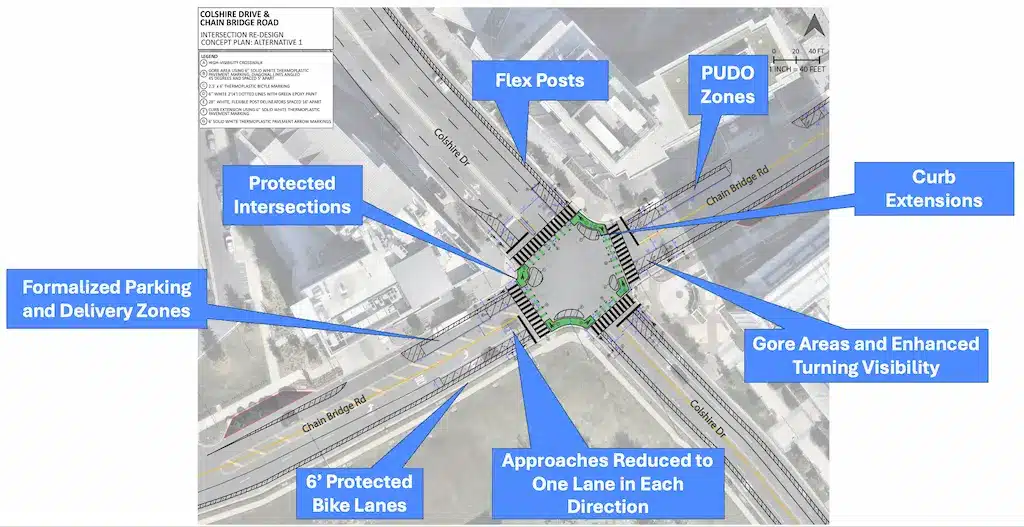
The first concept reconfigures the intersection to incorporate protected bicycle lanes and simplify travel lanes to one in three directions. This approach would introduce physical separation for cyclists, improve clarity at the stop-controlled intersection, and reduce driver confusion associated with multiple receiving lanes. This concept significantly increases on-street parking, and creates designated curb uses such as pickup-dropoff and loading where it is needed the most due to land uses and building designs. It would also coordinate with Fairfax County’s broader protected bike lane corridor project, creating a more cohesive network connection to McLean Metro and surrounding destinations. This concept maintains today’s stop sign control.
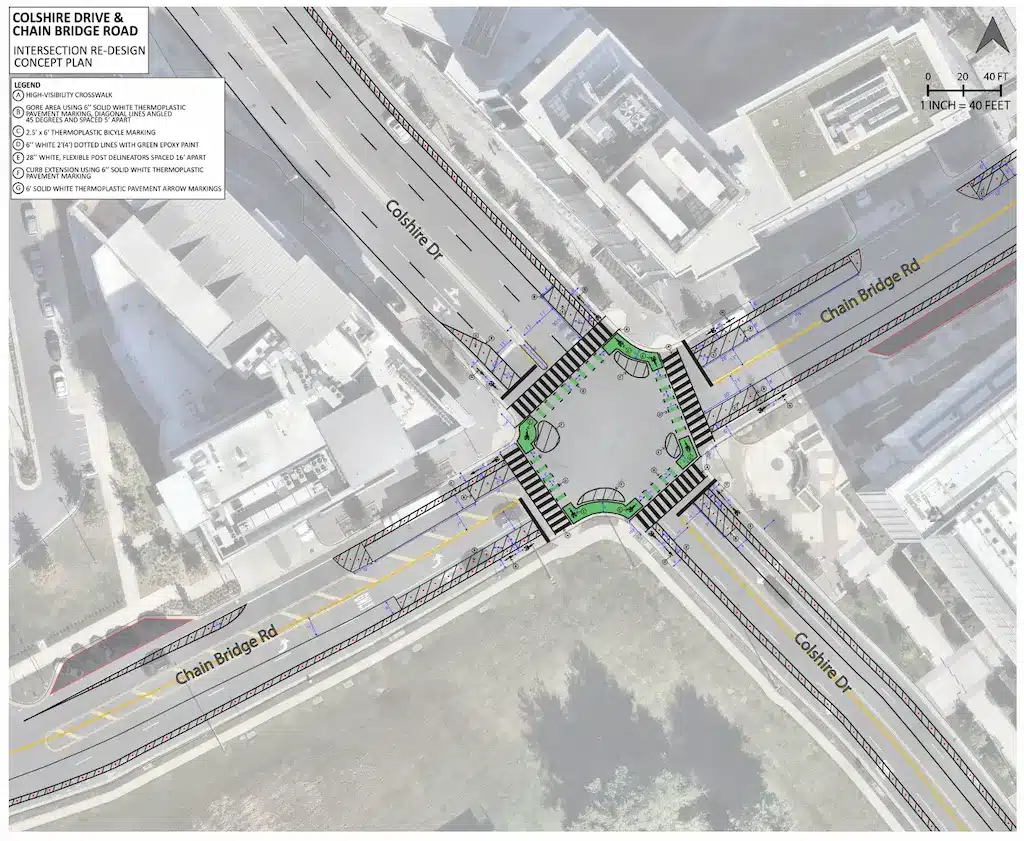
Concept 2 is the fully signalized version of the first concept. By simplifying lane assignments, this concept improves driver decision-making, reduces conflicts associated with the existing multi-lane stop-controlled intersection, and creates opportunities to better organize curbside space. Traffic analysis indicates that this concept would significantly improve intersection operations compared to future no-build conditions while providing a familiar traffic control system for all users.
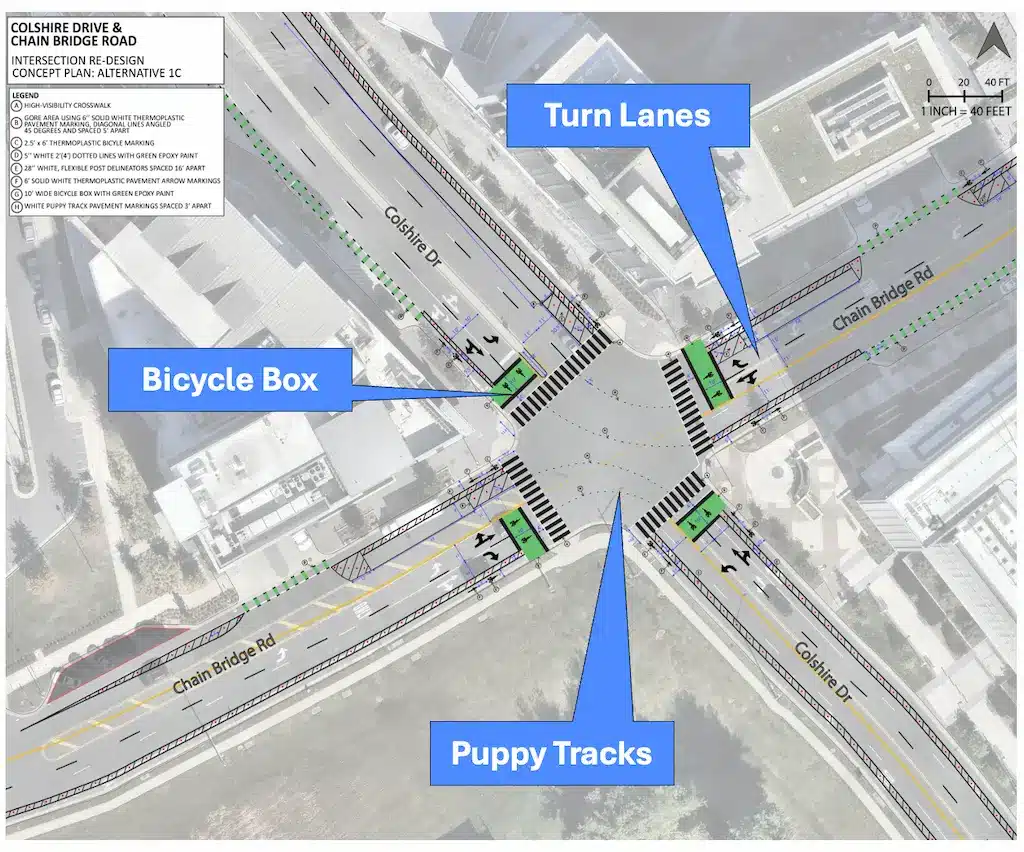
The third concept maintains all-way stop sign control while reconfiguring the intersection to include dedicated turn lanes and simplified lane geometry. This concept is intended as a lower-cost, quicker-to-implement improvement that still addresses many of the operational challenges observed today. The design reduces driver confusion at the stop-controlled intersection, provides more clearly defined vehicle movements, and creates opportunities for improved curbside management while maintaining the existing stop-controlled operation.

The last concept replaces the four-way stop with a one-lane mini roundabout. Based on preliminary analysis of traffic volumes and available right-of-way, a mini roundabout could meet VDOT design guidance while accommodating peak traffic demand well into the future. This option would slow vehicle speeds, reduce severe conflict types, and eliminate stop-sign decision ambiguity.
All concepts aim to enhance safety, improve operational clarity, and better manage the evolving mix of vehicles, pedestrians, cyclists, and curbside activity at this intersection. Further technical review and coordination with public agencies will determine how these concepts advance.